Online Exhibition - Indigenous Minnesota
Who Does the
USA Belong To?
The historic removal of Native Americans from wilderness and how this connects to ICE detainments in Minnesota today.
Arrow keys · click arrows · swipe
Chapter I - The Peoples
Who Lived Here
Before
Minnesota is home to eleven federal tribal groups. Four of them are Dakota (Sioux), the first ever people to settle in Minnesota, whose history goes back 9,000 to 12,000 years according to archaeological findings. The other seven are Anishinaabe-Ojibwe (Chippewa), who originally came from the northeastern part of America searching for a new land in which "food grows on water."
Both groups have deep connections with nature that are evident from their oral history. Wilderness was engrained within their cultures - click the boxes to learn more.
Bdote Memory Map - Dakota community resource - bdotememorymap.org
Chapter II - Dispossession by Law
The Treaty Era
& Land Removal
Prior to European arrival, 10 million Native Americans such as the Dakota and Anishinaabe inhabited the land. By 1900, European colonisation had reduced that number to circa 300,000; 130,000 in Minnesota. Whilst removing the people, Europeans also removed the land.
The U.S. government used the ideology of Manifest Destiny to justify westward expansion - centred on the subjugation and expulsion of Native peoples from their lands. Treaties were the legal instrument of this dispossession. In 1851, Dakota leaders signed at Traverse des Sioux ceding over 24 million acres. Many later said they had not understood what they were agreeing to. Secondary documents, appended after signatures, stripped the promised annuities. Within months the treaties were already broken.
The colonisation of America simultaneously subjugated Native Americans and the wilderness they inhabited.
GOVT
1851
Primary Source - Legal Document
Treaty of Traverse des Sioux
Click to read full context
CONG.
1889
Primary Source - Federal Legislation
The Nelson Act, 1889
Click to read full context
Chapter III - 1862
The U.S.-Dakota War
Following a series of broken treaties, deprivation of food, and settlers moving deeper into Dakota territory, the Dakota War commenced in August of 1862 and continued for six weeks. The consequences of the war were disastrous, not just for the Dakota people but also for the connection between the Dakota nation and the lands on which they thrived. Violence had entered into the wilderness itself that was being swallowed up by European expansion. Click each point to read more.
Chapter IV - 1820-1863
Fort Snelling:
Conquest in the Wilderness
The construction of Fort Snelling took place in 1820 on a piece of sacred land known to the Dakota Indians as Bdote, the place of origin of all Dakota life, at the confluence of the Minnesota and Mississippi rivers. The establishment of a military fort at such a location carried an implied message about possession of the territory. The fortress represented not only conquest of the wildness by humankind, but also control over the indigenous population of the region.
Following the Dakota War of 1862, 1,700 Dakota men, women, children, and elders were herded to a concentration camp near Fort Snelling, where hundreds of prisoners perished during the harsh Minnesota winter. Thus, the sacred place of life for the Dakotas became a place of death, while the wilderness that had supported their community for centuries was enclosed behind the walls of the very institution that deprived them of that land.
"This was our sacred place. This was the land where our people began."

Fort Snelling, Minneapolis
View on MNHS websiteHistoric Fort Snelling - built on Dakota sacred wilderness, 1820
The ICE detention facility stands 5 minutes from this site today
Chapter V - Primary Sources
Visual Evidence:
Land Managed and Lost
The purpose of the Nelson Act of 1889 was to move all members of the Anishinaabe community in Minnesota to the White Earth reservation, which was nothing but an encircled piece of land in the western part of the state, and sell off their vacated lands to the Europeans. The creation of the Nelson Act created a whole new idea about what could be defined as 'wilderness'. It was now a wilderness that was managed, bordered, and controlled according to Western ideas rather than according to native concepts.
Reservations were more than a place where Native people had been moved to. They represented the state's idea about managing the wilderness through its control over land enclosed by a boundary. The Anishinaabe had been looking after this piece of wilderness and maintaining it for years with the help of their own rules and regulation. But post-1889, these rules were changed. The wilderness was no longer governed by natives, i.e., those who had knowledge of it, but by the conquerors.
Ojibwe land holdings in Minnesota - before & after
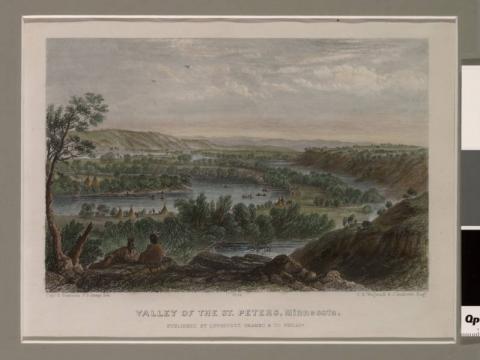
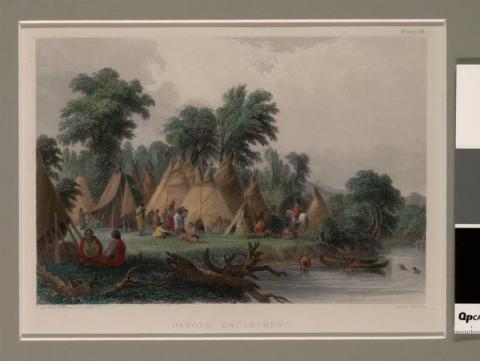
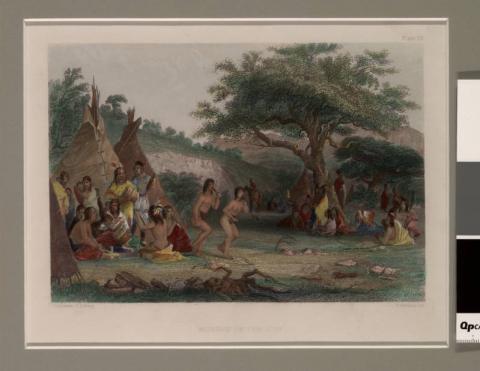
Click the artworks to explore their context
Chapter VI - Cultural Erasure
Civilise. Assimilate. Erase.
Boarding school policy by the federal government forced Indigenous children away from their families. According to the official goal, the purpose was to "kill the Indian, save the man." Indigenous languages, spirituality, and communication with their family were prohibited.
The disappearance did not only concern abstract notions of culture but also the knowledge of the wilderness. The Dakota and Anishinaabe children sent to the boarding school possessed generations' knowledge concerning the wilderness and all that comes with it - the flora, fauna, the rivers and lakes, as well as the seasons. The prohibition of languages meant erasing the words used to denote all of it. The abolition of rituals cut the link between the people and their place and landscapes. All the locations mentioned, the Fort Snelling, the reservations, as well as the boarding schools, are connected through the common purpose, decolonizing the Indigenous relationship with wilderness.
Click the words below to discover what was destroyed and preserved.
Policy statement, 1892
"Kill the Indian in him, and save the man."
- Richard Henry Pratt, founder of Carlisle Indian School
Resilience & Survival
Even though the cultures were subject to systematic repression, Dakota and Ojibwe culture endured. Cultural traditions, secret rituals, and community organizations helped maintain languages and wild lore. Today, both tribes conduct language immersion schools, cultural programs, and tribal colleges, as well as ecological knowledge recovery programs.
Primary Source - Photography
The Stella Stocker Photography Collection (1858-1925) captures aspects of Ojibwe culture in Minnesota from the period when Native children attended boarding schools; an uncommon visual perspective of life in contrast to the government story.
View collection → Minnesota DigitalChapter VII - The Wider Context
How This Links
to Wilderness Thinking
The contemporary treatment of Native Americans can be traced back to the Euro-centric and exclusionist views of conservationists during the nineteenth and twentieth centuries. The denial of indigenous culture began at the emergence of both conservationism and preservationist actions. Both concepts called for making America "for Americans."
The displacement of indigenous people was justified by the necessity to improve America through offering spaces that lack human presence and the possibility of the emergence of the Frontier concept. This corresponds to the contemporary notion that the elimination of "illegal aliens" would make America "American."
Two Eras, One Logic
| 19th C. Removal | 21st C. Deportation |
|---|---|
| Indigenous peoples framed as obstacles to progress | Immigrants framed as burdens on society |
| Narrative of the empty "wilderness" to be claimed | Narrative of an "American" identity to be protected |
| Law used to justify displacement of a community | Law used to justify removal of marginalised people |
| Indian Removal Act - executive authority to expel | ICE - executive authority to detain and deport |
Chapter VIII - 2025-2026
History Echoes
in Minneapolis
Operation Metro Surge in Early December 2025 saw the deployment of 3,000 ICE agents in Minneapolis-St. Paul's twin cities. This led to 3,700 arrests, two deaths by shooting, one shooting without death, and a minimum of 33 wrongful detentions. The article that had caused Operation Metro Surge was later revealed to be an exaggeration; its primary source claimed that he could "find no evidence" to corroborate al-Shabaab's statements.
There have been reports of Oglala Sioux tribe members, individuals with indigenous ties to this same soil, being arrested and interrogated about their claim to residence. The ICE detention center is located within walking distance of Fort Snelling, which had been used 163 years ago to imprison the Dakota nation.
Oral Testimony
Melvin Longclaw, a descendant of the Dakota people, gave his oral testimony based on stories he heard from his family as well as those he lived with in the Sioux Village in Canada - describing displacement, survival, and the unbroken connection to this land that no federal act could sever.
- MNHS Oral History Collection
| 19th Century | Today, 2026 |
|---|---|
| Treaties signed under coercion strip Dakota of land rights | Legal status used to justify removal from communities |
| Fort Snelling used to intern 1,700 Dakota people | ICE facility built 5 minutes from Fort Snelling |
| Dakota exiled from Minnesota by executive order | Indigenous tribal members detained on ancestral land |
| Federal government defines who belongs on the land | Federal government defines who belongs on the land |
Final Thoughts
Who really has the right
to be on this land?
Minnesota has been built upon land taken from the Dakota and Ojibwe tribes. The wilderness that was not just next to them but belonged to them in every possible way and had been known, named, controlled, and comprehended for millennia. The wilderness revered by the Americans in the 19th century as unpopulated was created through clearing those people away. The very government that forced the Dakota to leave their land is now making decisions on whose place will be left on that land.
The Operation Metro Surge took place on stolen land only five minutes from the place where the Dakota were interned 163 years ago. The wild rice lakes of the Anishinaabe remain here. So does the Bdote, the place of convergence of two rivers. However, those who knew the most about all these things were removed, and the rationale for this removal is still present.
This project has been designed to pose questions regarding citizenship in America and its criteria. The history begins right here, with the indigenous population of this country.
Exhibition Sources
Bibliography
Primary Sources
Indian Removal Act, 1830
United States Statutes at Large, 21st Congress, Session 1, Ch. 148. loc.gov
Treaty with the Sioux - Mdewakanton and Wahpakoota Bands, 1837
Digital Library of Native American Treaties, Oklahoma State University. dc.library.okstate.edu
Treaty of Traverse des Sioux, 1851
Ratified Indian Treaties, 1722-1869, National Archives. archives.gov
Nelson Act, 1889 (Fiftieth Congress, Session II, Ch. 24)
United States Statutes at Large, Vol. 25, p. 642. govinfo.gov
Longclaw, Melvin. Oral Testimony (Dakota descendant)
Minnesota Historical Society Oral History Collection. mnhs.org
Seth Eastman: Depictions of Native American Life (c.1840-1855)
Minnesota Digital Library, Primary Source Sets. mndigital.org
Stocker, Stella Prince. Photography Collection on the Ojibwe in Minnesota (1858-1925)
Bdote Memory Map - Dakota community interactive resource
"Oglala Sioux Tribe says it cannot confirm tribal members were detained by ICE in Minneapolis"
MPR News, 16 January 2026. mprnews.org
Minnesota Native American Newspaper Archive
Minnesota Historical Society. newspapers.mnhs.org
Secondary Sources & Museum Resources
Westerman, Gwen and Bruce White. Mni Sota Makoce: The Land of the Dakota
Minnesota Historical Society Press, 2012. Essential study of the Dakota relationship to their specific landscapes.
Warren, William W. History of the Ojibwe People
Minnesota Historical Society Press, 1885 (reissued 1984). Written by an Ojibwe author - a foundational primary account of Anishinaabe history and their relationship to the land.
Treuer, Anton. Ojibwe in Minnesota
Minnesota Historical Society Press, 2010. Comprehensive overview of Ojibwe history, culture, and contemporary issues in Minnesota.
Treuer, David. The Heartbeat of Wounded Knee: Native America from 1890 to the Present
Riverhead Books, 2019. A counter-narrative to the idea of Indigenous decline - covering survival, resistance, and contemporary Native life.
Anderson, Gary Clayton. Kinsmen of Another Kind: Dakota-White Relations in the Upper Mississippi Valley, 1650-1862
University of Nebraska Press, 1984. Detailed history of Dakota-settler relations in the region leading up to the 1862 war.
Kugel, Rebecca. To Be the Main Leaders of Our People: A History of Minnesota Ojibwe Politics, 1825-1898
Michigan State University Press, 1998. Focuses on Ojibwe political agency and resistance to dispossession in Minnesota.
Minnesota Historical Society. Fort Snelling: Dakota People
National Park Service. "What Happened on the Trail of Tears"
Minnesota Historical Society. Mille Lacs Indian Museum and Trading Post
Carleton College. Research Guide on Indigenous People in Minnesota